
EVIL URSA – A LOOK INTO
SUPERMAN’S SADISTIC
VILLAINESS
INTRODUCTION
When the Theatrical Cut of Superman II was released in the Winter of 1980, first in Australia, and ultimately in the US in June of 1981 the world had finally gotten to know the mysterious female villainess of General Zod’s trio – Ursa – who was banished to the Phantom Zone in the opening scene of Superman: The Movie in 1978. Described by Jor-El (Marlon Brando) as a woman, “whose perversions and unreasoning hatred of all mankind have threatened even the children of the planet Krypton,” her screen time in the titular superhero film was brief, only a promise of crimes to come. She, Non and Zod were immediately sentenced to the eternal prison and it left audiences to wonder when and if she may return and engage in her evil deeds. With Jor-El’s formidable description came the deliverance of her character in Superman II and Ursa triumphed, becoming the premier female villainess of the Christopher Reeve Superman films. Ursa is an archetype for the modern super-powered female villainess – one who is equally strong and intelligent, with Amazonian qualities and a streak of feminism, but in the end sadistic, yet with an engaging and graceful quality. Ursa was brilliantly realized by actress Sarah Douglas in a role she beat out 600 other actresses for and it became career-defining for her.

 |
| The People That Time Forgot |
 |
| Publicity photo from "Superman: The Movie" |
 |
| The Brute |
 |
| The Brute |
 |
| Glamour photo of Sarah Douglas |
 |
| Beautiful photo of Sarah Douglas from the late 1980s |
There are several versions of Superman II that are available – The Theatrical Cut released in 1980 (in the US in 1981), the 2006 Richard Donner Cut (both of which have been released in 4K by Warner Brothers in 2023), and extended Television Cuts from the 1980s that circulate on the underground online market. With all of the alternate versions of the same film, that’s a lot of material to sift through and this essay essentially is an in-depth study of the character of Ursa from her origins to how she was realized in all of these versions of the same film by Sarah Douglas. We'll delve into the psychological make-up of the character, including motivations and strategies as she is an unusually evil and cunning villainess. She is an attention-grabbing secondary villain, a mysterious force to be reckoned with; sort-of like a Boba Fett for the Reeve Superman series. Ursa is also a character who was nearly-universally praised upon the film’s release and who has built a respectable cult following in the years since. There are numerous drawings, memorabilia, photos, toys (official and unofficial) and designs of her character constantly circulating; various appearances of her in DC Comic Books since 2006; fan sites like www.Ursasworld.evilsupergirls.com; tributes on Facebook and numerous websites; she has appeared in the 'DC Super Hero Girls' cartoon in 2019 and in 'Scooby Doo! and Krypto Too!' in 2023; and, even has a song dedicated to her - “Ursa, Queen of the Universe” by Gareth Rhodes on YouTube.
 |
| Drawing by Scott Blair |
 |
| Action Comics "Enter Ursa" |
 |
| One of many numerous fan creations |
 |
| 3D Art |
 |
| Action Comics' Ursa |
 |
| Ruby-Spears Superman 1988 |


Ursa is standing tall (and flying high) and perhaps stronger than ever. Yvonne Blake’s costume for Ursa worn by Sarah Douglas recently sold for over $43,000 in a November 2022 Propstore UK auction. Nevertheless, especially as she is the pioneer female comic book super-villainess in modern film, Ursa is terribly underrated as the Reeve films are essentially the starting point for when superhero movies became more than cheap B-serials and children’s material. There was never a female villainess in a comic book serial, show or film with powers like hers before she first came on the screen in 1978. As Sarah Douglas said about Ursa, in an interview with the San Francisco Sunday Examiner and Chronicle in 1981, "I stand for nothing but evil." It's amazing to think that the first Superwoman ever portrayed in a major motion picture was not a heroine like Supergirl, but instead Ursa - a woman who used her powers for evil.
CREATION OF CHARACTER
Ursa (which is Latin for ‘She-Bear’) was co-created at the same time as the Faora Hu-Ul character from Action Comics #471- #473, who debuted in May 1977 in a story by Cary Bates. A little over a month before that, Sarah Douglas was cast and started filming as Ursa for Superman: The Movie and Superman II. In the comics, Faora is a criminal sentenced to the Phantom Zone for running a private concentration camp for males on Alezar. Faora wears a green and white spandex outfit with blue boots and is an expert in the Kryptonian Martial Art Horu Kanu – something that may have also been in the early development for Ursa as her previous crimes are vaguely defined by Jor-El in the original film.


As Ursa was present in the Superman film scripts at least a year before Faora’s debut, it seems that when Mario Puzo met with Action Comics writers Cary Bates and Elliot S. Maggin in 1975 during the writing phase of the first two films, it’s possible to assume they exchanged ideas about creating a female Phantom Zone villain. That being said, as Puzo’s scripts have become available online for the first time in January of 2023, Ursa is completely absent. Puzo has four Kryptonian villains (all male) and Zod plays a minor role compared to what he does in the finished product. As the film naturally went through its own developmental phases separate of Action Comics, it appears logical there was no true plan by the writers of the comics and the subsequent writers of the first two films (Leslie Newman, David Newman, Robert Benton and Tom Mankiewicz) to match these characters. Ursa shows up first in the Newman, Newman and Benton script dated July 1976, however there was a Norman Enfield draft done in late 1975 in between when Mario Puzo left and the Newmans took over where she possibly could have originated. Ursa and Faora, however, seem to grow out of the same basic concept. The Tom Mankiewicz shooting script from early 1977 describes Ursa as “a strikingly beautiful, but cruel woman obsessed by an all-consuming hatred of the male sex.” Ursa is also described as “a languorous, undulating Rhine Maiden, floating down through the darkness… a smiling magical apparition.” In the 1976 Newman, Newman and Benton script she is described as “A woman whose beauty makes strong men weak.”

 |

In all versions of Superman II, the characters of the three super-villains very nicely contrast one another and Sarah Douglas had great onscreen chemistry with her co-stars Terence Stamp and Jack O'Halloran. Zod is totally consumed by power – a megalomaniac. His only objective is the subjugation of all he surveys which makes him especially arrogant. Killing was secondary to his lust for power. Non is a hulk and doesn’t exemplify intelligence which sometimes makes him appear child-like, but he is loyal to Zod and unleashes his brute force and destruction with Zod’s direction. Ursa is also loyal to Zod, but is a curious character and seems to only enjoy seeking debauchery. Ursa is in many ways a more vicious and sadistic villain than Zod or Non for this reason. She is brutal, harsh and has nothing but malice for every earthling she encounters. Zod clearly understands Ursa’s need for violence and he uses that by letting her do what she wishes under the tolerance of his rule. This trade off sees her serve Zod so she can revel in her evil ways without consequence which one would assume was their relationship on Krypton. Her evil need to inflict pain through the violence she causes makes her the most terrifying of the three. She enjoys it.
KRYPTON
Ursa and the villains are introduced at the trial on Krypton. Each villain looks quite fearsome as Jor-El describes their crimes. Ursa stares down Jor-El as he passes her, presenting his case to the jury. Ursa does not have dialogue but interacts with Jor-El by stepping forward toward him when he tells the jury of Ursa's perversions and hatred of all mankind. It's a marvelous dolly-in shot, which along with her stepping forward give her a dark and evil close up. As Jor-El puts the core of the blame on Zod for the insurrection plot, the jury quickly decides on their guilt and the villains nervously wait their punishment - their instant imprisonment in the Phantom Zone. As they fly off into space, this is we see of the villains until they are accidentally freed by Superman in Superman II. It's a brilliant set-up and for Ursa, the audience gets the very simple message that she is definitely a villainous woman.


THE MOON


If one is to understand the character of Ursa, one should go no further than the moon scene which really serves as her true introduction in the Superman films. Her sequences are perfectly shot and are a study on how to economically and effectively define a character in a single scene. Ursa never shines brighter in the spotlight than here, where she displays all of her signature characteristics. It is for that reason this scene will be thoroughly broken down here as it is the centerpiece for all aspects of her character and it’s also one of the only scenes Ursa has in which she does not share the screen with Zod and Non. At this point in Superman II, of the three villains, Ursa is the one we know least about. Zod was well-featured in the first film in his memorable scene facing off against Jor-El. When the second film begins, in the prologue of the Theatrical Cut, Non gets to show his character's strength by breaking the neck of a Kryptonian guard right before the three villains are captured. By the time the villains escape the Phantom Zone and get to the moon, Ursa is still something of a mystery to audiences. Will she just be a pretty face at General Zod's side like many passive female villains from 1970s who tend to stand next to the male villains and look sinful? From the three villains’ point of view, they have just been freed from their intergalactic prison and do not know who the white-suited humanoids on the moon are. Zod, being the General, does not approach first nor does he send Non first; instead, he sends Ursa, which is a bit of a surprise to the audience as Non is clearly the strongest. As Ursa is the last whose villainous deeds the audience is introduced to, it is here on the moon that Sarah Douglas gets the opportunity to steal the show!

Ursa first flies past the lunar capsule as she scouts out the ship. She makes eye contact with Nate, who is inside the capsule, and after listening in on his conversation with “Houston” she chooses to fly past him and pursue Andy who is heading away from the ship. Ursa is a perceptive and intelligent character and chooses to confront and surprise the outlier enemy (Andy) who does not have the protection of his ship, which is what you would expect from a soldier working for a General. She always puts herself in a position to give herself full advantage over the human men she faces throughout the film and this scene establishes that.
The most impressive characteristic of Ursa in this scene is her fearlessness. Ursa performs the most courageous act of any character in the entire film as the villains, having just been freed from the Phantom Zone, do not know if they are stronger than the astronauts or not. The viewer must remember that from her standpoint, Ursa is risking her life if she is wrong. Ursa wisely chooses not to fly, as Nate had seen her do, and instead chooses to boldly walk directly up to Andy's face to intimidate him. She clearly must have landed and been walking for some distance as he doesn't look up and see her until she is a relatively short distance from him. She does this while also trapping him between two large sets of moon boulders on each side, leaving him only his reverse for possible escape as she essentially ambushes his position. By hiding her ability to fly from him, if he was a formidable foe, she could use that power to her advantage if needed. This strategy works perfectly as Andy’s eyes pop open and he comes to a dead stop from his moon trot at the sight of her walking with fluid gait as if she were on Earth, and amazingly without a spacesuit! Ursa comes across as having supreme confidence in herself in every moment.

 |
| The tint in the Donner Cut appears blue-ish compared to the Theatrical Cut above |
“You,” she demands of him. He can only mutter, “uh,” as she continues inquisitively, “What kind of a creature are you?” Ursa’s strength is measured by her statuesque posture with her right hand fixed on her hip. When he meekly responds, “Just a man,” she amusedly replies, “A man?” Finding out that this creature before her is “just” a man underneath the suit, she is clearly pleased and senses her upper hand. The way that she says, "A man?" is condescending, as if she's laughing at him.


Ursa then rises from the moon’s surface and brazenly flies above the astronaut. She appears to still be studying him as she stares down while effortlessly flying high above and past him. His head is down; unaware of her location, and with his momentum giving him nowhere to go, Ursa this time strikes with no warning by landing straight down at his face. Ursa shows here she is a woman of action by wasting no more words with the terrified astronaut and immediately rips the insignia off his spacesuit giving him no chance to retreat this time. She slightly raises her head in superiority as she watches him fall backward.

One wonders if she may have suspected this man needed to breathe inside his suit. She also may have been irritated by his brief escape. Ursa now makes it clear it's not enough for her to simply watch him die and she simultaneously tests her new powers. In this moment, she reveals the true nature of her character and the “perversions” that Jor-el spoke about. Ursa indulges in an act of pure sadism by punishing the downed astronaut with a violent kick to his groin.


What the character of Ursa does in the moon scene is establish her modus operandi for the rest of the film. With her dialogue she depicts her character's curiosity and her objective - here it's to find out what kind of creature he was. With her physical strength, she goes and gets what she wants. Here she intimidates him, she uses her power of flight, she tears his insignia and she shows her combative skills to play just as hard as the other supermen in this film. In just over one minute of screen time, Ursa is shown to be intelligently strategic, fearless, forceful, amused, curious, annoyed, sadistic, violent, a misandrist, and ultimately satisfied. Quite a lot of character packed into a short scene and brilliantly realized!
CINEMATIC BREAKDOWN OF URSA ON THE MOON

It’s worth the time to closely look at the framing, image composition, character blocking and action of how this scene was filmed, as this establishes a subtext for Ursa’s terrifying and intimidating character for the remainder of the movie and also illustrates why this scene is so effective and memorable. If you don't like the dryness of shot-by-shot analysis, please feel free to skip ahead to the next section about Ursa on Planet "Houston." The Moon sequence was shot under Richard Donner's direction and we'll take a deep look into how this classic scene was photographed and edited.

The suspense for the audience begins with Nate spotting Ursa flying past his capsule, giving us a bad feeling for how the villains will interact with these astronauts. Incidentally, in this shot Ursa's character begins her pattern of crossing the film screen from the right side of the frame toward the left. Her movement toward the left of the screen exemplifies how her character is dominant over the humans and is a superwoman. She moves in the direction she chooses to and they are helpless to impede her.

The film then cuts to Andy progressing in a close up of his feet shuffling. He continues trotting unfazed until he looks up and stops at a halt in shock of something, as we see his eyes bug out in a close up. There are three


In the following shot, from his point of view, Ursa is walking directly at him (or at the audience as Sarah Douglas is walking directly toward the camera) between the two moon rock boulders, giving him and we the audience the feeling there is nowhere to escape as she fearlessly comes to confront him. This is doubly shocking because she is already so close to him, yet calmly walking directly to his face.


They first meet together in the same shot when she enters the frame of his next shot, a wide shot where she is walking from the right side across to the left, cornering him into the left end of the film frame where he has been standing at a halt. This puts the audience in the astronaut’s shoes, with the feeling of his being outmatched by someone who doesn’t need a spacesuit to be on the moon. The first time you see the film, the audience gets the feeling of nervous butterflies the way this scene is set up.


"You!"


"Uh"

"What kind of a creature are you?"


"Just a man"

"A man?"


Upon learning he's a man she raises her eyebrows in condescending amusement. Again, Sarah Douglas gives us another layer of Ursa here, as her eyes light up at his response. Ursa had been clearly prepared to confront the humanoid creature, but learning he's a man clearly gives her a sadistic joy now. As Ursa mockingly smiles at him, he seems unsure of her motive and almost seems to be admiring her momentarily, looking her up and down. That moment quickly turns to fear as Ursa spots his badge and her eyebrows lower as her expression turns dark. She no longer has any interest in talking with him and is focused on taking his emblem and ultimately killing him.


Each time when she moves across the film frame, her character takes control of the space within the frame, giving the astronaut "nowhere to go" and suffocating the space in the film frame with where he can escape - essentially "boxing" him in the left side in every film image. He then turns around and on the reverse angle runs from screen right to screen left. However, the previous shots established that moving from screen right to screen left is Ursa’s dominant screen direction starting with her initial contact, so this tells us that his character is destined to fail in his attempted escape back from where he came. The suspense continues to build as the audience knows she can fly and he doesn't, so his impending doom is palpable as in the wide shot we see her impassively fly up and over from the right side of the film frame towards the left easily catching up.


Sarah Douglas flies with such elegant fluidity here, and throughout the film, and demonstrates her great skill to handle the demands of performing with a wire harness rig and her physical acting adds to the sense of terror. There is a brief shot from Ursa's point of view as the camera passes over him.

When she lands in front of him in the Theatrical Cut there is a rather frightening image of her coming out of the darkness, stealthily emerging, barely visible in her all-black outfit.


As he looks up he sees her, shocked that she flew far ahead of him, but it is too late. She again invades his screen space going from screen right to the screen left to tear his metal patch off, “like paper.”


The next image is a beautifully composed wide shot as he falls to the moon’s surface on the far left side of the frame with her standing over him in the middle left of the frame. This exemplifies to the audience the feeling that he has been completely outmatched and the horror she can be capable of to all mankind. It may be the most prototypical shot for her character in the film, standing over a downed man. And again, she has stopped his movement and kept him stuck on the left side within the film frame. He was never able to progress forward to the right of the frame and she has now completely stopped his movement.


Ursa now gives the slightest impression of an evil smile around her lips and in her eyes – a brilliant exquisite touch from Ms. Douglas in a close-up showing Ursa indulging in the sadistic pleasures in her mind. What we don't know yet is that in this moment she is choosing how to wickedly end this man's existence and that instead of just watching him, she wants to inflict even more pain. Sarah Douglas has an understated approach to her acting in these shots, showing us the unfolding confidence and pleasure in the mind of her character with flawless facial expressions.


In the next wide shot, she literally sends him off the screen and into the void of space, as he flies off into the far left of the film frame. Andy's character was never able to move from the left side of the frame to the right side of the frame in this scene despite every attempt and in the end he is sent to his death endlessly flying back to the left side of the frame. In terms of their characters' blocking, she completely subdues his character's attempts at progressive movement in every frame. More importantly for her character, as she has just been freed from the Phantom Zone, she is again fully realized to be the killer she is. Ursa firmly establishes her power as a character for the rest of the film subconsciously to the audience through how this scene is blocked and shot.


The close ups of Ms. Douglas in this scene are evilly glamorous and there is a vicious elegance to how she walks, flies, moves and behaves as Ursa and this perfectly establishes her as a supreme villainess for a superhero film. As mentioned, it's worth noting the music in the Theatrical Cut is much more suspenseful and highlights the key actions of the scene better than the music in the Donner Cut which is rather unfitting and un-dramatic.

In this showcase scene for Ursa, we watch her grow as a character as she is able to survey, confront, and easily triumph.
In contrast with the other villains, Zod is given only 50 seconds of screen time for his kill on the moon (the second of the trio's three killings), which is done rather impersonally. Zod hides behind the moon rocks and engages in a brief tug of war with the cosmonaut’s air cord. It’s not as bold or as engaging as Ursa walking right up to her victim. Zod is equally cold and callous, but he doesn't develop the moment of relation with his victim as Ursa did with Andy. He makes a brief comment to himself about Boris' fragility and as the Cosmonaut floats, Zod yanks the cord from him. Non gets about 45 seconds of screen time for his kill. We don’t see Nate die, but we do see Non unleashed to destroy the ship and Nate beginning to be crushed as Non gets his villainous moment, but Non also doesn't interact with his victim. In the end, Zod dispatches Boris by pulling his air hose from a distance and Non crushes down the ship, inevitably dispatching Nate. Unlike Zod and Non, Ursa physically rips and kicks her victim, first grabbing Andy's space suit and tearing it open and then gratuitously kicking him. This physical behavior and her up close interaction with her victim along with being the first to kill, demonstrate how her character's personality thematically drives this entire sequence with great unease and terror for the audience.

(*And an interesting fact - Ursa wears two space insignia after this moon scene. The blue one on her waist is from Andy, whom she killed, but the gold one encircled in red that's on her right chest is from Boris, the Cosmonaut. This means after she killed Andy that she must have found Boris' body and took his insignia. Is this a possible deleted scene? This may explain why when Zod and Non ride the moon cart to the lunar capsule where Nate is, Ursa is trailing behind them.)


Ursa's up-close and personal killing of Andy is the most shocking part of Superman II and most certainly the cruelest death in the series of the four Superman films. At this point in the Superman series, no humans had been killed onscreen. That she is a woman and is the first to kill was rather shocking to a 1980 audience and pioneering when looking at it today. If there was any question that this female villain was just going to be eye candy at General Zod's side, it disappeared instantly for the audience here. Ursa is fearlessly confrontational in how she murders her first victim and Sarah Douglas' acting imbues and heightens the scene with a raw intensity. Ursa's actions set the tone here for the impact the villains can have for the remainder of the film, and for herself, Ursa establishes her uniquely visceral quality of evil. In terms of violence, there’s really nothing the villains do or could do after this that could shock the audience as much as here.
URSA ON PLANET “HOUSTON”

The moon scene began the pattern that whenever the trio of villains encounter a new life form or situation, Ursa is the first to make contact. She is the first to discover life forms on earth when she encounters the snake; She is the first to face the police officers on the road; She is the first one in the saloon to interact with the townsfolk. Ursa is without a doubt the General’s lead attacker and is an inquisitive scout and this is a large part of what makes her character interesting. Upon landing on earth, she eagerly picks up the “primitive” snake and examines it; letting it slither over her arm with no worry.


The snake snaps quickly, biting her hand. Ursa reacts by angrily throwing it to the ground and seems more startled than hurt. This scene has caused a bit of a debate online amongst fans for years – was she actually hurt by the snake bite? She initially reacts by holding her hand, but then shows no signs of pain as the shooting script indicates:
150 FAVORING URSA – Unhurt, but annoyed, she throws it to the ground. She scowls and glowers at the snake.
The ultimate point of this scene is to show her discovering her heat vision as she stares in anger at the snake, burning it to a crisp. Again, her emotions turn to satisfaction and elation, “I have powers beyond reason here!” Zod is not particularly amused and Non is unable to access his heat vision, apparently because he’s not angry enough.


Next, upon meeting the deputy on the dirt road, was a scene that was different from the earlier script drafts. In the Theatrical Cut, she confronts the deputy, but simply rips his badge from his uniform after tauntingly asking him if the badge means that he follows another leader. She mocks him by invading his space and stroking his badge up and down as she speaks to him and she seems very gratified when tearing it from his uniform. Her actions end there, however, as the violence in this scene was toned down and implied rather than exhibited. In the Mankiewicz 1977 draft, she first bends his gun when he attempts to shoot her, and she then snaps the deputy’s wrist, proving he is no match for her and leaving him in agonizing pain. She tells the officer, “You will not die yet. I will keep you alive to play with,” and the scene ended with her advancing on him.


 |
| In a deleted scene she surprises the deputy trying to get away |
As the trio come to meet the people of the small town, Ursa cannot resist joining in with the arm wrestlers. When she and Zod enter the saloon, she eyes the two men arm wrestling. The badges, the snake, the arm wrestling – everything seems to catch her curious eye. She walks in with a superior confidence; at first staring down the arm wrestler who has stood up (Boog) and then facing the arm wrestler at the table by standing above him, looking down at him. This mirrors her scene on the moon when she at first stares at Nate in the capsule and then decides to face Andy first. Ursa actually startles Boog as she circles the table and walks directly toward him. He takes a step back, clearly intimidated by her, but then she makes a turn and decides to face the man at the table. The arm-wrestler, in all his sexist arrogance, insults her and tells her to sit her “buns” on his lap. Ursa stares at him, giving him no pleasure of a reply; her imposing body language says it all and she has clearly decided who she wants to hurt next.


Ursa was considered a bit of a feminist character when the film came out and she clearly never indulges this kind of man’s (or any man's) insulting remarks. Ursa instead goes to sit across from him and places her right elbow on the table raising her hand toward his. She says her famous line, and only line in the scene, “Let’s just hold hands,” and as he grabs her hand to arm-wrestle, she instantly sends him down, breaking his arm right through the table, crashing him to the floor and knocking him out cold. Her mockingly coy look towards Boog after this is priceless Ursa, as if she's saying, "I'm just a girl."


Ursa has surprisingly little to do in the wreckage of the small town. She does begin to show some impatience with Zod when she complains about the slow unfolding of their powers. As the local newsman tries to report before the camera, she angrily says, “Enough of this man! If the whole world is watching, cannot we show them something more interesting?”

At this point Zod and Non get into the action. This scene was scaled down from a concept in an earlier script in which the villains destroy cities around the world in a montage. Essentially they destroy the small town and deface Mount Rushmore before they head to the White House. However, Ursa does get to impressively cap the carnage with the only two onscreen deaths of the scene when she uses her super-breath to blow down an attacking helicopter.


Ursa ridicules the soldiers' needing helicopters, “Look, they need machines to fly,” upon her first sight of how humans fly and, at Zod’s suggestion, unleashes death with a kiss and a regaling smile. The fact that the only men in the film who get a kiss from Ursa die a fiery death is a tribute to the lethality of her unique mix of femininity and misandry. It is at this point Zod realizes there is nothing that can stop him on Earth. Sarah Douglas’ facial expressions in this scene again show Ursa relishing the pinnacle of her power, defeating not only humans, but their technology as well.


WHITE HOUSE
Ursa, in the Donner Cut, gets a deliciously icy moment that is one of her few improvements in this version of the film as Ursa appears in less footage in the Donner Cut. In the White House scene in the Theatrical Cut, the entrance of the villains is quickly edited and paced. Ursa gets to inflict three particularly cruel deaths in both versions of the film. As she lands through the ceiling, Ursa again makes the villains' first contact as she grabs the first guard by the face and throws the petrified man high through the roof of the White House to a presumable death. The anger on Ursa's face as she attacks him is a look that in itself, can kill. Sarah Douglas, after Ursa's landing, rises up in a lightning-quick motion. It's very believable the guard doesn't even have a moment to react and Ursa has already sent him through ceiling.


Each version then varies as she continues to throw several guards who approach her. However, her killing of one agent is given a much more suspenseful edit in the Donner Cut and depicts her ice-cold cruelty. As we near the end of the havoc, the agent gets knocked to the floor, losing his weapon and desperately kneels down while covering his head, trying to avoid the wrath of Ursa who is heading directly to him. Ursa firmly stops in front of his cowered body with a priceless nonchalant look on her face, waiting for him to look up at and acknowledge her. There is a tense moment of cutting back and forth after which he reluctantly uncovers his face to see if she has gone, only to find her standing right over him and staring directly into his eyes. In a beautiful close up, Ursa has a wicked expression - a thin smile and a then a wink of her eye - and with this she gives him one brutal kick to his face, snapping his head backwards killing him instantly. Leaving his body at her feet, she then turns and gets in a lethal elbow to an attacking agent’s throat, effortlessly dispatching him as she catches up to the patiently-waiting General Zod and Non. With her Kryptonian strength, it's inevitable both these guards died from her swiftly forceful blows to the head and throat, just as the two guards Zod shot and the guard Non throws through a brick wall are implied to die. Lingering on a character's moment of death is not PG material and also would slow the pace of the havoc in the scene.


Inside the oval office Ursa continues to get in verbal and symbolic digs against men. In a scene added to the Donner Cut, she cannot resist insulting and then tearing the insignia from the Generals with a delicious line, “What a backward planet this must be – where the men wear the ribbons and jewelry.” This is a great scene that really showcases the equality of Ursa to Zod as supervillains. Zod first tells the President that he can save lives starting with his own. Ursa then starts walking after this and the whole room stares at her wondering what she is going to do. It's a great little scene for her because she continues to threaten and menace just as much as Zod.


General Zod, again, allows her to have her moments of indulgence and this scene illustrates their symbiotic relationship. When Lex Luthor arrives at the White House, Ursa has to be stopped by Zod to not break his bones, and to her satisfaction, damages one of Luthor’s fingers when he has the gall to try and hold her hand as he tries to sell Zod on his talents. She literally follows his every step, waiting for Zod to give the word, but Luthor’s promise of delivering Superman keeps Zod from letting her get what she truly wants. However, the promise of "Revenge" against Jor-el excites her. Sarah Douglas plays Ursa as a laser-focused villainess in her stalking of Luthor (seriously, no pun intended;).


METROPOLIS BATTLE


After Zod goads Superman into returning, the battle of Metropolis starts with mostly Non and Zod fighting Superman. Ursa mysteriously evades Superman, mocking him after he says he isn't a coward. "Let him prove it," she retorts. She then sets him up by luring him into Non’s grip by grabbing Superman by the throat from behind. Shortly after, Ursa almost gets to strike Superman with a flagpole before Non loses grip on him at the last second and she ends up sending Non into the top of the Empire State Building with her “home run” swing. Ursa later memorably knocks down Superman when she hurls the manhole cover into his stomach. This is another instance of her hitting a man when he’s down as Superman is emerging slowly out of the manhole when she blindsides him.

 |
Ursa expresses to Zod that Superman is a “sentimental idiot” about his caring for people and she quickly uses that to her advantage by getting Non to help her throw a bus full of people at Superman, which hurts him so badly it causes him to realize he cannot defeat them and he retreats the battle in defeat.

In this first battle of Superman vs. the villains, it is ultimately Ursa’s idea of crushing Superman with the busload of people that wins the battle for the villains. Unlike Zod who is thrown into the Coke sign and Non who is thrown about the city by Superman, Ursa doesn’t suffer even a moment of failure in the entire battle (and the entire film to this point) until the final battle in the fortress. The villains cap their carnage by using their combined super-breath to blow the citizens of Metropolis down.


 |
| Victory at Metropolis! |
FORTRESS BATTLE
  |
| A deleted scene when the villains must combine their strength to penetrate the forcefield protecting the Fortress of Solitude |

The Fortress of Solitude is where Ursa faces her only defeats in the film. When the three villains use their finger beams to strike Superman, he reverses all their power to knock down Ursa. When Zod demands they attack him and they all surround Superman's holographic images, Ursa makes the first strike for the villains, as she has throughout the film, by squaring off against Superman. The shooting script makes it explicit that Ursa has “her boot up, aiming for a super-kick at his groin.” However, to her surprise, Superman is just projecting himself as a hologram when her super-kick passes through Superman's holographic image.
 |
| Ursa using Kryptonian Martial Arts, like Faora |


It’s a shame we didn’t get to see a full physical battle between the two, but in 1980 it didn’t match Superman’s wholesome image to fight a woman, even one as evil as Ursa. Ursa's only moments of defeat in the entire film are here at the end as she is denied the fight she so desperately wanted with the Man of Steel. The kick she gives appears to be a martial art kick, possibly Muay Thai, and she kicks with such force that she falls down, incredulous at his trick. Was this a reference to the Faora character from the comics who used Kryptonian Martial Arts?
 |
| Ursa still looking glamorous in defeat |

Fans clamor over the new superpowers and inconsistencies in this scene, which do seem a bit rushed in development. It seems to make no sense that earthling Lois, with her leg, pushes Kryptonian Ursa into the abyss. It’s certainly inconsistent with the rest of the film, such as at the Daily Planet when Lois punches Ursa and nearly breaks her hand, and it doesn’t even cause Ursa to flinch. Superman’s new powers and tricks at the fortress confuse each of the villains. Ursa is able to recover from being pushed over the ledge and flies back behind the crystal walls, and with Non, grabs Lois promising to Superman to tear her apart. At this point, Ursa no longer lets go of Lois’ neck, and in the Donner Cut is about to snap it, but Zod has a moment of mercy. After Superman depowers the villains from his crystal chamber and disposes of Zod and Non fails to fly, falling off the ledge, Ursa is given the sendoff all moviegoers wanted as Lois got to punch evil Ursa into the abyss. For the villains, the story has come full circle as Ursa was the first to attack on the moon and the last to be defeated in the fortress.
INTELLIGENCE

It can be argued Ursa proves she is a better strategist than Zod by the end of the film, but demonstrates her intelligence throughout the film. On the moon, she is the one who listens in on Nate, learning the planet the astronauts are from. Her cunning strategy of how she took down Andy, as detailed earlier, show her excellent planning. With her consistent fearlessness, she tests the villains’ powers by being the first to interact with the earth creatures in each scene and learns from her victories as she bests each of them decisively. She puts the human men on the spot with her dialogue in every scene and they're forced to quickly figure out how to respond to her.
 |
| Ursa always intimidates and advances on victims |
With the astronaut she demands he answer her questions. With the East Houston deputy, she walks right up to him and asks him, "What is this symbol?" to which he is unsure of himself and just repeats her words, "Follow a leader?" as she tears his badge right off his uniform. The arm wrestlers catcall her and she turns the tables on them to insist they "hold hands." Throughout all versions of the film, she calls the shots and she is able to dictate the human mens' reactions by initiating insults and violence towards them. And she is efficient in demanding the earthlings respect Zod, with her lines, "General Zod does not take orders! He gives them," "He's the General!" and "Come forward, your General wishes to speak."

Ursa also stares down her victims in constant acts of intimidation. Intimidation is probably her greatest tactic. She does this with her words, her threatening stares and advancing on every victim. Every man in the film, from the astronaut to the men in the bar, to the deputy and to every guard in the White House that dares attack her have to respond to her intimidating tactics. She knows what she is capable of and she shows no mercy for every earth man. When she stalks the astronaut, she literally stares him down, walking straight at him before he even knows it. When she enters the bar she stares down several of the men before deciding to encounter the arm wrestler and not taking her eyes off him until he is on the ground, passed out from her devastatingly breaking his arm. This fierce attitude is part of her character and present throughout every version of the film. Ursa acts; the men react, which makes her a classic antagonist. These advances are highly intimidating and the men nervously have only moments to try to fight back.

Ursa has no patience for Lex Luthor and it’s only Zod’s will that keeps Luthor alive from Ursa’s wrath. Ursa, with great malice, in the Donner Cut has what may be her very best line in every version of Superman II when she demands to kill Luthor at the Daily Planet, yelling at Zod, “Let me kill him!” Zod’s repeated trust of Lex Luthor along with his lust to defeat Superman ends up being their undoing. Had she been allowed to kill the scheming Luthor as she wanted, Superman would have had a much harder time figuring out how to trap all three of the villains.
 |
| Ursa hates Luthor, seeing through his scheming at first sight |
In her battle with Superman in Metropolis she conceives several sneak attacks against Superman, from strangling him from behind mid-air to catching Superman off guard when he emerges from the underground when she hurls a damaging manhole cover at him. Superman never seems to know where she is, and she humorously taunts him calling his name, "Superman" as he struggles to see where she is. She appears to use her all-black outfit to her advantage as he never seems to see her coming in the night sky as she is constantly elusive in this battle.

In the Donner Cut she grabs him from behind and strangles him as she mocks him with a delicious line, "What? You'd hit a woman?" knowing she has figured out his boy scout image to her advantage and he holds his punch, confused as to what to do. Ursa keeps a superior attitude to Superman and really seems to want to tear him apart. Sarah Douglas is terrific in this moment, and seems to have a very strong grip on Reeve's neck. 
Ursa is the one who gets Non to combine their strength and overpower Superman by throwing the bus at him and it's Ursa who decides to take Lois Lane as a hostage when they go to the fortress, “Why not increase his handicap?” she mused aloud as she grabbed Lois.

Ursa’s singular focus to threaten and kill the humans proved unstoppable for Superman to overcome. Zod, Ursa and Non had defeated Superman in Metropolis, but by going to his home at the Fortress of Solitude, Zod gave up his advantage by letting Superman fight them on his home turf, where he had secrets (including new powers like the infamous “Cellophane ‘S’!”) to defeat them. However, as this is a Superman film, of course he has to win and his intelligence saves the world. But, Ursa was clearly an outstanding, clear-minded, cunning and highly intelligent strategist in her own right.
BEAUTY/COSTUME

Part of the character of Ursa, as described in each of the drafts of the script, is her beauty. Ursa, in her portrayal by Sarah Douglas, is a glamorous, statuesque woman, but her obvious attractiveness is not focused on too much throughout the film, it’s just referred to as if it's understood by everyone. It was prominent in the advertising and press for the film. In the Topps trading cards for Superman II in 1981 Ursa’s profile card labels her as “Beautiful, but Deadly Ursa” and quotes Sarah Douglas, “While the kids will hate me for my wickedness, their dads should say, ‘Well, at least she’s sexy.’”

Her character is described as, “Ursa – as evil as she is beguiling. Flashing her consuming hatred for men with her seductive beauty, the Phantom Zone villainess Ursa sears human males with her heat vision and chills them with her cyclonic breath.” Her introductory card in the 1978 Superman Topps set is a close up and simply calls her, “Villainess Supreme.” Numerous magazine articles upon the film's release highlighted the striking beauty of the character in the portrayal of Sarah Douglas.

Her character is described as, “Ursa – as evil as she is beguiling. Flashing her consuming hatred for men with her seductive beauty, the Phantom Zone villainess Ursa sears human males with her heat vision and chills them with her cyclonic breath.” Her introductory card in the 1978 Superman Topps set is a close up and simply calls her, “Villainess Supreme.” Numerous magazine articles upon the film's release highlighted the striking beauty of the character in the portrayal of Sarah Douglas.


The costume of Ursa was designed by Academy Award Winner Yvonne Blake and consists of a one piece “jumpsuit” made of sheer black voile (which is slightly see-through) embellished with reflective black faux leather piping. All three villains have similar costumes, however Ursa's costume is tailored quite differently from the mens' costumes. There are long slits along the sides of the arms and legs that show off the extremities, and the outfit is completed by black patent thigh high leather boots (which were very deep dark brown/black, but that photographed on camera as black).


The boots have high heels and at the top of the thighs come to a sharp highly angled point. These slits along the sides of the jumpsuit along with the high heeled boots added to the sex appeal. She also has a very distinct make-up design. The S.F. Sunday Examiner and Chronicle (June 14, 1981), in a profile on Sarah Douglas, noted Ms. Douglas was also given upraised eyebrows, bright red lipstick (a feminist trademark), false black fingernails and pale white make up. In Starlog #47, Sarah notes her real-life long hair was pinned up under a short-cropped wig to play Ursa.

Ursa has sideburns which come to a sharp point accentuating her striking cheekbones; and with the short hair and a lack of skin showing, these somewhat tomboy-ish qualities were intended to give her an other-worldly, alien-like allure. Sarah is quoted in Starlog #47, “I felt she should appeal to kids and dads, and even goats for that matter.” Along with the descriptions of Ursa’s beauty from the scripts described earlier, in all versions of the film characters' comments regarding her looks are imply her beauty throughout the film.
 |

Nate, the astronaut, comments when he sees her undulating, “It’s might pretty out there…mighty…Pretty!" Zod asks “dear” Ursa to “blow a kiss” to the men in the helicopter poised to attack them. In the Donner Cut, when Luthor is introduced to Ursa via the crystal in the Fortress of Solitude, Miss Teschmacher has to poke Luthor to stop him from staring at her too long. He later tries to touch her by holding her hand in the White House and gets his finger crushed. Of course, the arm wrestlers in the saloon all stare her down and one of them catcalls her “sweet thing,” telling her to sit on his lap.


In a scene possibly (and seemingly likely) filmed from the Donner-filmed Mankiewicz script, instead of her saying, “You are master of all you survey,” just before Luthor arrives at the oval office, Ursa enters that scene as we hear a man’s scream cut off in the hall, and she says to Zod, "I'm bored with this puny planet. The men here do not even try to resist anymore." In the Donner Cut we first see Ursa sitting on the desk, examining her fingernails. In the Theatrical Cut, she is examining a toy model of the Universe. So, it's likely this scene was cut and never put in any version as the Theatrical Cut is clearly a reshoot of just the opening of that scene. Also, in the Donner Cut, Perry White calls her “A broad that looks like the queen of the runway!” - Sarah Douglas very much embodies a woman who could walk the runway in great style, but a "broad" is certainly a derogatory word today and not an embodiment of Ursa's character - the feminist in her wouldn't stand for that. Ursa is ultimately a stunning woman, beautiful and glamorous and with great mental and physical strength.
PHYSICALITY


 |
| Perfect landing |
Close views of the various versions of the film show Sarah Douglas seemed to do the high majority of her own stunts. The flying scenes are numerous and she was held in the air by a complicated wire harness rig, becoming the first woman to fly in a comic book film. Sarah flew with such proficiency that Ursa easily has the most regal style out of the Kryptonians in how she flies and lands. After all, not only did she have to do everything Christopher Reeve, Terence Stamp and Jack O'Halloran did, but she had to do it in heels! The role was incredibly demanding on the actress as she notes in Starlog #47, “Many, many weeks go by and you don’t actually speak any lines. You’re just flying (on the high wires).” She had to endure long hours having body molds made of her for special effects shots. Emphasizing her strength and equalness to the men, Ursa is the villain carrying Lex Luthor on her back for the long flight to the fortress instead of the much lighter Lois Lane, who is carried by Non. The role was a tremendously physical one and Ursa’s hits, throws, kicks and flying are nearly all done with Sarah Douglas’ face and body visible to the camera.


Ms. Douglas nailed the manhole cover scene in one take, flipping the cover up into her hand and hurling it directly at Superman in one fluid motion, amazing the crew and her director Richard Lester - who didn’t have an alternate plan if she couldn’t handle the dexterity and precision required of the throw.

Ursa is constantly in the middle of the action, flying, fighting, hitting, throwing and kicking and the only physical action we don’t see her character do, is run. Ursa never chases anyone or anything; she lets everything come to her and relies on her powers, intelligence and skill to get her through. She is very smart and very physical and clearly does not need any of the men to do anything for her. She seems to relish showing off that she can handle anything as well as any man and is really the only female character in the film that is so physical. There are no female police or other female characters like that on earth to combat her. Ursa shows throughout the film she can handle and does not fear any man - human or super.


Sarah Douglas had to take on all of these daily physical challenges to project the image of Ursa as physical and yet darkly elegant onscreen and she made all of these scenes look easy, further dictating her performance is an absolute triumph. Her character is always aggressive, assertive and motivated and she never backs down from challenging everyone and everything, including Superman.

Also worth noting, from the physical violence that is present in all cuts of the film, Ursa has the highest onscreen death count of all three villains, or of any villain in the Christopher Reeve Superman films! The 6 deaths she inflicts are the astronaut, the two soldiers in the chopper and three guards in the White House. (By comparison, Non kills 4; the Kryptonian guard in the intro, an astronaut, and in the Television Cut, a White House guard thrown through a brick wall who presumably dies, and the boy on the horse, at Zod's behest. Zod kills 3; the astronaut and the two White House guards he shoots in the Donner Cut). Other characters are hit or thrown by the Kryptonians, but they appear to move after these blows, so it appears they are just injured. Of course more deaths are implied from the villains taking over Earth, but in this film and series of films, Ursa excelled as a physically deadly Femme Fatale.
MAN-HATING

Sarah Douglas in the February 22, 1979 edition of The Daily Mirror (just after the release of Superman: The Movie in Great Britain) stated, "I knew I'd made it when 'Gay News' wrote that I looked suspiciously butch. Wait till they see my man-hating role in part two." Sarah further described Ursa, in the S.F. Sunday Examiner and Chronicle in 1981, "I'm just a good old downright bad person. I do a bit of gooching around, kicking men off the Earth and placing my thigh length black leather boots in tricky spots. Crucial spots, actually." She also conveyed an amusing observation of how she had to talk about Ursa's man hating in the different countries she promoted the film. "The Australians are a bit raunchy and I was able to say, 'Ursa kicks men in the b--ls. In South Africa I had to be more gentile and say: 'Ursa kicks men in the groin.' In America? Oh, they don't have any b--ls at all in America." These wry comments on the differences in cultures are exemplary of the sharp wit Sarah Douglas often employs in interviews. The origin of Ursa’s character when she was designed in early script drafts was as a woman driven by her hatred of men (and similarly to Faora Hu-ul's development in the comics). The explicit man-hating was trimmed down from the original scripts to her portrayals in both the Theatrical and Donner Cuts, but the core of her creation still is prevalent throughout. The Television Cuts of 1984 and 1988 include deleted scenes that exhibit very explicit dialogue such as her “Men to kill!” pronouncement on the moon and also a curious scene in the East Houston town. In this scene, Zod orders Non to throw a police siren hundreds of yards to kill a boy escaping on his horse. It inexplicably explodes when it hits the boy, but what most people seem to always remember about this scene is Ursa’s response. A woman protests to Zod, “He was only a boy.” Ursa in a moment of sadistic elation retorts, “Who will never become a man.”
 |
Clearly this scene was deleted due to the child’s death being too violent for a Superman film. In earlier drafts of the script, the man-hating aspect also came out in other dialogue such as from Jor-el’s original introduction of her which was once, “You, whose countless men have suddenly become accident prone” and in a later draft, “On the woman, URSA, whose perversions and unreasoning hatred of men have finally threatened even the male children on our planet.”


Incidentally, in earlier script incarnations there was a fourth Phantom Zone villain, a trickster named Jak-el, whom Jor-el said terrorized children. When shooting of the film began, this trait was transferred to Ursa as spoken by Jor-el in the opening scene. When there were four villains in the first Newman draft (which can be found online) Ursa had very little to do and was something of a minor character (along with Non), while Jak-el was clearly second to Zod. In that Newman, Newman and Benton 1976 draft, the villains landed in Australia and not East Houston. Ursa, again has a much smaller role, but has one big scene in what was the equivalent of the small town scene, when she encounters a rough male character named Johnny Greer, who probably ended up in the Theatrical Cut becoming Jody - the man Zod levitates and drops to the ground. From the script -
JOHNNY GREER: You're not. . . You're not. . . a man.
FAVORING URSA, MED.: She advances on Johnny Greer, vamping.
URSA: (mockingly) But you are. . .
JOHNNY GREER: Beat it, sister. I've seen your kind before.
URSA: You never will again!
She knees him in the groin with the force of a howitzer at close range. Johnny screams and falls to the ground.

She obviously did not get to knee the townsman in the groin in the film, but ironically her kick to the astronaut's groin is not in any version of the script. So, her man-hating seemed to have been being worked on as they were filming her scenes. One wonders if there are still more deleted scenes of Ursa inflicting groin pain on men, as again, Sarah Douglas has cheekily referenced in interviews such as the one referenced above of Ursa being a woman who kicks men in the b--ls. In all film versions, however, she is described as a threat to all mankind. Ursa’s distaste for Lois Lane keeps her character from becoming exclusively man-hating because all her damage and destruction is aimed at male characters. She hates Lois at first sight and delivers a wonderful belittling line upon meeting her - "What an undemanding male this Superman must be." However, when looking at her character more closely, nearly every one of her actions seems to be aimed at emasculating men, both symbolically and in actuality, and illustrate her being a woman embodying being physically and intellectually superior. We've looked at the face value of her scenes in Superman II, so it's worth a look at the symbolism and subtext of Ursa's violence and behavior in the many versions of the film as they represent her misandry.
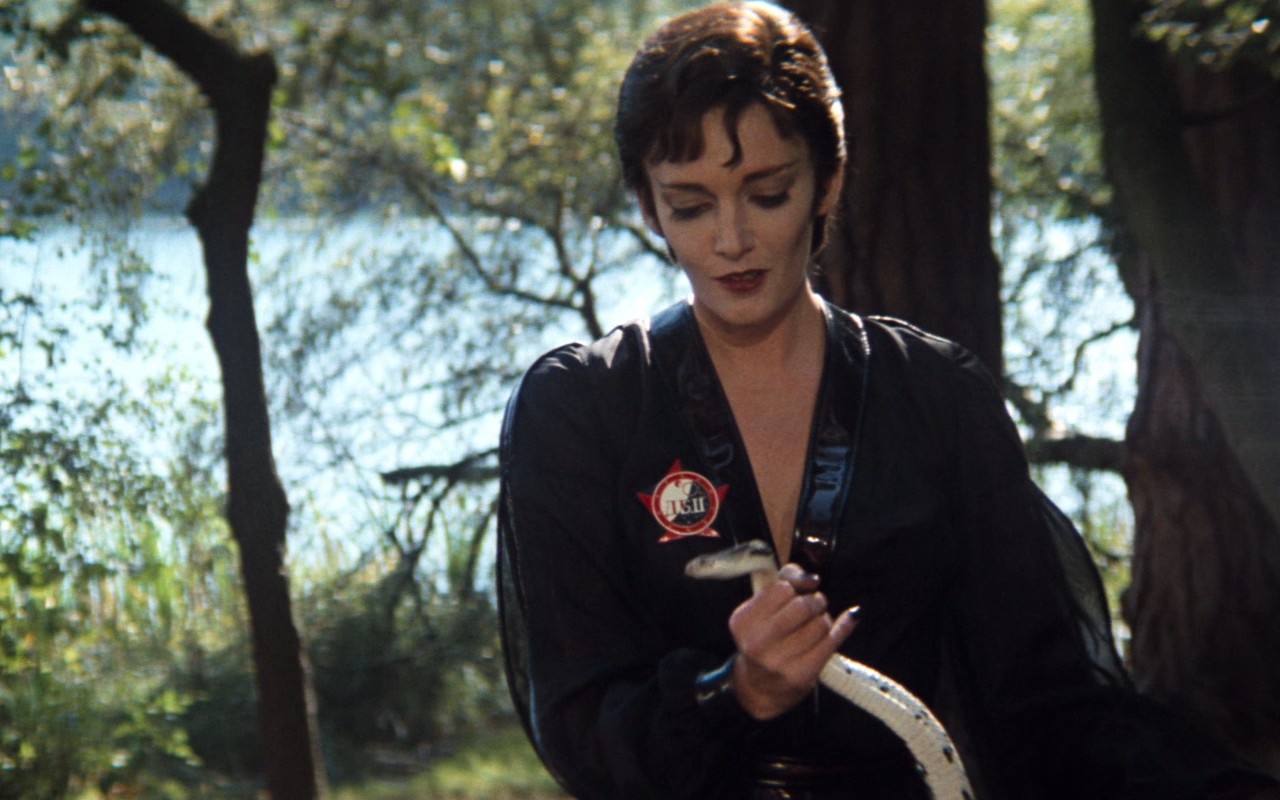
In the forest, Ursa grabs the snake and in her anger to its’ attempt to bite her, she burns it with her eyes – snakes are seen as an almost universal phallic symbol throughout history - and Ursa’s enmity for men is symbolized in her reaction to it; On the moon, Ursa first causes the Astronaut to flee and drop his tool, a symbol of his manhood, and his demise comes from her kicking his actual manhood;

In the battle of Metropolis, she rips the flag pole (a phallic object) off the building and swings it at Superman and ultimately slams Non into the top of the Empire State Building with a “home run,” suggesting a superiority to both of them; Non also is hit directly into the spire, again suggesting a phallic object.

She humiliates the arm wrestlers in their own saloon, beating them at their own game, breaking the man's arm through the table; In the White House, she terrorizes the guard who tries to hide at her feet, and after teasing him, fatally kicks him in the face (a trait of hers is she never makes the remotest effort to bend and face the men who are down, she simply stands over them and kicks them);

Ursa easily tosses the guards in the White House who are powerless with their manly weapons and guns against her, including grabbing one by his necktie and throwing him (the man's tie being a phallic symbol; Ursa, in the Donner Cut, again shows her superiority to Non when, during the flashback that Luthor views of her in the fortress, she grabs Non’s arm and forcefully lowers it down as Jor-El describes her crimes;

Also in the Donner Cut, when looking carefully, it appears to be Ursa who fractures the monolithic Washington Monument as the villains fly by (it's definitely most consistent with her character that she would destroy it); A "kiss" from her kills the soldiers in their armed chopper;
 |
| Imagine if Ursa completed this devastating kick... |
Ursa’s man-hating ultimately leads to her hatred of Superman. Her fight with Superman in Metropolis has her knock him out by hitting him in the waist with the manhole cover and later in the fortress she aims her super-kick at his groin. Had Ursa really had been able to connect, this would have been a devastating blow! Her hate for Superman was supreme, but in 1980 it was not acceptable for a female character like Ursa to have kicked him in this way nor for them to have had a proper physical fight. In a deleted scene, at the White House, when Zod says he wants to bring Superman to his knees, Ursa adds the word, "Praying!" This deleted line, while a small moment, illustrates her need to inflict cruelty and her wish to punish the son of her jailor by making him pray for mercy and should have been kept in the final cut. When she strangles him from behind in the battle of Metropolis, she does it with great hate and, again, had it not been 1980 she was in a perfect position to deliver a brutal kick on him while he was in her grip.
 |
| Ursa, highly decorated in male insignia |
Throughout the film, Ursa takes only male characters’ insignia, military ribbons and badges at her pleasure and posts them on her outfit. This taking of badges or "trophies" even exhibits a darker, more depraved serial-killer-like behavior in how Ursa kills and/or humiliates all men she encounters that of course, is not explored in a PG film. The limits of the PG rating and the era this was filmed only allowed her to do so much damage. It appears by the end of the film she has at least ten badges and insignia and she is very well-decorated. Had she been given a fair fight with Superman, one wonders if she would have torn his 'S' logo from his chest! This all being said, Ursa defeats every type of masculine archetype throughout the film - an astronaut, policemen, arm wrestling cowboys in a saloon, military men in their chopper, armed secret service guards, military generals, and in Metropolis, even Superman himself. Despite attempts to scale back her man-hating, it appears it was too ingrained in the entirety of the script and remained a major character attribute. And again, the Topps trading card gives it away saying she hates men!
DOMINATRIX LABEL

Ursa's man hating leads to the sort-of “elephant in the room” question that is sometimes written about her character. Was Ursa a dominatrix? Starlog #111 in 1986, in a profile on Sarah Douglas, stated Ursa was called a “leather-clad dominatrix” by movie critics and numerous articles at the time described her as that. Though she shows not even a moment of any type of expressive sexuality in any version of the script or film, the label has been loosely, and perhaps unfairly, associated with her character since the film’s release. She does not appear attracted to any man (or woman) and appears asexual in all versions of the film. As there is no direct or overt sexual characterization with her character, this description of Ursa is ultimately up to the viewer.
Cinematically, as described above, there is a lot of symbolism going on with Ursa – some of it obvious - such as that Ursa is a character obsessed with symbols! In looking at how she is presented, right from the start she comes off as an evil woman, always in complete control of herself. Her actions are essentially any combination of ordering around, attacking, humiliating, mocking and killing male characters she confronts, who are dressed in traditional uniforms of men who are “good.” By contrast to these traditionally dressed heroic men, Ursa is dressed in all-black from head to toe.

The appearance of her fighting these men is therefore very classic good versus bad. Her black outfit, as described above, was designed with a wicked and sexy edge to it. The black patent boots are very tall, coming up near the top of her thighs and are arguably the most dominatrix-like part of her outfit. "Men LOVED the boots," Sarah Douglas noted in an SFX interview in 2006. Physically, Ursa is a very tall woman (Sarah Douglas is 5'10" and with the heels, over 6') and she towers over most men she encounters in the film. Her not needing to breathe, her ability to fly, and her super-strength clearly exude dominance and she naturally embodies these very strong characteristics. These qualities, along with her sadistic perversions that Jor-El spoke about, are all archetypically displayed in her entire scene on the moon, again where the audience truly meets her.


When people over the decades have called her a dominatrix, it's this type of behavior and symbolism that they are most likely associating that claim to. Ursa is both symbolically and in actuality taking away his manhood. It's her first real scene and the audience is introduced to her depraved, callous behavior. Each subsequent time in the film that Ursa tears badges, ribbons and symbols from men, it calls back to her behavior of violently killing the astronaut by taking his badge and then kicking him. This is still a PG rated film though, so if anything, this scene acts as an establishment of her pure unabashed hatred for men and her later actions act in harmony with this, even if not all her actions are as malevolent. Each time she takes a badge or insignia, she is emasculating each man. She is never literally a dominatrix, though.

Some look at the Superman character metaphorically as a Christ-like figure and Jor-el as God-like, giving his only son to the human race. The villains too have been seen allegorically, as some have called Zod a Lucifer stand-in. Film characters and stories can be looked at as substitutes for many other social stories and roles in life. So, it can be plausible that Ursa can be seen as a character who, while not explicitly sexual in any way, could be viewed metaphorically as a dominatrix. Even the space shuttle she helps attack is named Artemis II, after the Greek Goddess of the hunt, which is metaphorical. Ursa is other-worldly and untouchable for human men and earth creatures. Again, even the snake is incinerated for attempting to bite her. The men who get "kissed" by her die. She is somewhat symbolically, the "real Artemis" the astronauts encounter. With her Goddess-like powers, if she is to be described as a dominatrix, perhaps she may more accurately be described as a divine one, if you will, or you can simply look at her character at face value - an effective villainous killer.
CRITICAL AND FAN RECEPTION


Sarah Douglas was the only cast member to do worldwide publicity for the film and was prominently featured in many interviews and articles in 1980-81. Fans would be amazed at how warm, engaging and charming she was and how this contrasted so much with Ursa. In the S.F. Sunday Examiner and Chronicle (6/14/81) again, Ms. Douglas wittily noted, "People ask me how I can be so evil, when the real me is so different, so civilized. In England, we simply call it acting." Her portrayal of Ursa received excellent reviews at the time of release and also in recent years, as reviewers visit the classic Christopher Reeve Superman films. A cursory search of reviews show she has nearly universal positive reviews. “Slinky”, “sultry”, “un-ladylike” were descriptions of Sarah’s performance in contemporaneous reviews as people tried to rationalize how a female could be such a baddie at that time. The legendary film critic, Pauline Kael, in 1981, stated “This Ursa has the kind of face cameras worship and she does her dirty deeds with blasé’ nonchalance and the merest flick of a malicious smile.” For Pauline Kael to be impressed, you know you had to have done something right. Jack Mathews of the Detroit free Press in 1981 stated, “Sarah Douglas is fun to watch as the man-hating Ursa, dressed from the Nieman-Marcus catalog of outer space S&M-wear.” David Denby of New York Magazine called Sarah Douglas “devastating in her shiny interplanetary dominatrix rig.” Cinefantastique’s review described her as an “arrogantly sensual bonus.”


 |
| A photo of Sarah from the DC Movie Magazine of Superman II |
LEGACY

With both official cuts of the film re-released on 4k by Warner Brothers in 2023 we can get an even better look at the character of Ursa in Superman: The Movie and Superman II. As much as Richard Lester’s vision of the production differed from Richard Donner’s, both directors must be credited with allowing Sarah Douglas ample screen time to create a memorable character. The earlier drafts of the script gave Ursa much less to do. Her scenes on the moon, in the saloon, and even in the battle of Metropolis are all expanded upon from earlier drafts. While Richard Lester’s scenes may have been more comedic, Lester’s Ursa scenes are a little less comedic than most of his other scenes. Again, in Starlog #47, Sarah Douglas states, “(Lester) allowed Ursa to have a little moment of ecstasy when she’d get angry.” Combined with Ursa’s stark actions from Richard Donner’s scenes, Ursa has a personality of curiosity and viciousness that are linked together seamlessly through the amazing performance of Ms. Douglas.

This could not have been an easy role to act, given such production changes.
Jor-El spoke of Ursa’s perversions. Her purpose seems to be of inflicting cruelty. Each of the men she humiliates, conquers and kills is for the pleasure she gets out of it. Ursa shows no mercy and no pity. Sarah Douglas’ performance is slightly understated at the right times and at other times is unleashed for the audience, to both join in with and be shocked by Ursa's actions. Ursa's joy and curiosity at her superpowers are what makes her so interesting. She attracts us with this behavior along with her beauty and her style and she then turns us on our heads with her ruthlessness and violence, and yet still charms us with an evil grace. Ursa is a cold-blooded vixen who relishes the terror she inflicts, yet does it all with a magnificent charisma and commanding poise.

Ultimately, she is a fascinating character and one who deserves a second (or first) look from today’s comic book film enthusiasts. Characters in films of the 2020’s are written in a more self-conscious way than characters from forty-plus years ago, who were just “acting” or “behaving” without continuously commenting on their inner-monologue as is the trend today. Watching Superman II, we have to look at the details of the actress' performance to try to surmise what Ursa is thinking and who she is, and Ms. Douglas gives us a lot to think about. Ursa is very clearly is an equal to Zod and is treated as such. She does not truly need Zod, but clearly serves his power-hungry wishes and gets to fulfill her perverse wishes in return. She is a powerful and strong-minded independent woman and this makes Ursa a consummate villainess. Like other great characters in classic films, we get more detail out of her in each repeat viewing. Sarah Douglas' truly brilliant performance has stood the test of time all these decades later.

Perhaps Sarah Douglas herself said it best, in an interview with the Daily Mirror in April of 1977 when it was first being announced publicly that she had won the part and was beginning production. Regarding her role as Ursa, she is quoted, “I may not have much to say but I promise that people won’t forget me.” 45 years later and counting – we have not.
